Family Liturgy for Lent.
Ash Wednesday service moved to “Ash Friday”
*Ash Wednesday Service moved to “Ash Friday”*
With the expected bleak forecast tomorrow, in consultation with the elders, we have decided to move our Ash Wednesday Communion Service to Friday. So, we will have an “Ash Friday Service” instead at 6:30pm Friday, with a 5:30pm fellowship meal.
I will however be available at 7:45am and 12 noon tomorrow for any who wish to receive ashes on Ash Wednesday. This will be a short rite with prayer, reading, and the imposition. Individual confession and absolution will also be available, for any who desire it.
In nomine Jesu,
Pastor Hendrix
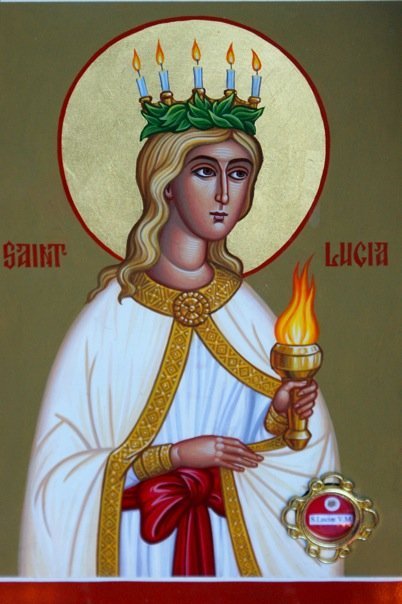
St. Lucia
On December 13th, the Church remembers St. Lucy.

History of St. Lucy
Lucy of Syracuse was born in 283 A.D. She was martyred when she was only 21 during the last and most violent persecution of the church during the time of the Roman Empire, called the Diocletianic or Great Persecution. This was less than 200 years after the time of the Apostles. Her death date is believed to have been December 13, 304 A.D.
In the year 303, the emperors rescinded the legal rights of Christians and demanded they follow traditional Roman religious practices (pagan practices, i.e., worshipping Jupiter).
Lucy’s mother, Eutychia, who was suffering from a bleeding disorder, feared for Lucy’s future if she should die. Against Lucy’s will, she arranged for Lucy to marry a young man from a wealthy pagan family. After Eutychia was healed, Lucy took the opportunity to persuade her mother to distribute her wealth to the poor, supposedly saying “…whatever you give away at death for the Lord’s sake you give because you cannot take it with you. Give now to the true Savior, while you are healthy.”
News that she had given her wealth away came to the pagan man she was betrothed to, who then denounced her to the governor of Syracuse. The governor ordered her to burn a sacrifice to the emperor’s image. Lucy, like other Christian martyrs, “chose to obey God rather than men” (Acts 5:29) and so was martyred. According to legend, St. Lucy had her eyes gouged out before her martyrdom. This imposed blindness was supposed to be a message to Christians, that they shouldn’t think about “seeing” or “knowing” anything negative about the Empire.
Customs of St. Lucy
Lucy’s name shares a root (luc) with the Latin word for light (lux), Because a number of legends have her eyes being removed, she is connected – ironically – to sight and light.
It is Christ after all who is the Light of the World (John 8:12). Because of the Light that was born into the World at Christmas, the entire world is redeemed and has everlasting light. All those who die or are martyred in faith have become a “saint in light” (Col. 1:12) and are now gathered around the throne of Light in Heaven, “clothed with white robes, and with palm branches in their hands” (Rev. 7:9).
In Scandinavian countries, particularly Norway and Sweden, her death date has become a festival of light. Girls dress as Lucy – wearing the clothing of all the saints described in Revelation 7 – a white robe, with palm branches, as well as a red sash for martyrdom, and a wreath of candles symbolizing the eternal light of Jesus revealed at His first Advent.
Remembering saints isn’t about them at all, but about Jesus
Unfortunately, like our own customs of St. Nicholas, the actual customs of Lucy’s feast/death day are often distorted by the culture and twisted into something that removes Jesus from the picture. This is particularly true in Scandinavia which, although the countries are predominantly Lutheran, are more Lutheran in name only rather than belief or practice.
Saints are simply those who have been “washed clean by the blood of Jesus” (Rev. 7:14). Remembering the history of the church and men and women (saints) who have gone before us is good for Lutheran Christians to do. We do this whenever we celebrate Reformation (when we remember Martin Luther), or whenever we have a Christian funeral (when we remember the person who is now a saint). But neither funerals nor Reformation are for or about the human people, they are about what Jesus has done for them and continues to do for us. Remembering their example can help us realize that every generation of the church must believe for themselves and “contend earnestly for the faith which was once for all delivered to the saints” (Jd. 3).
Come and See!

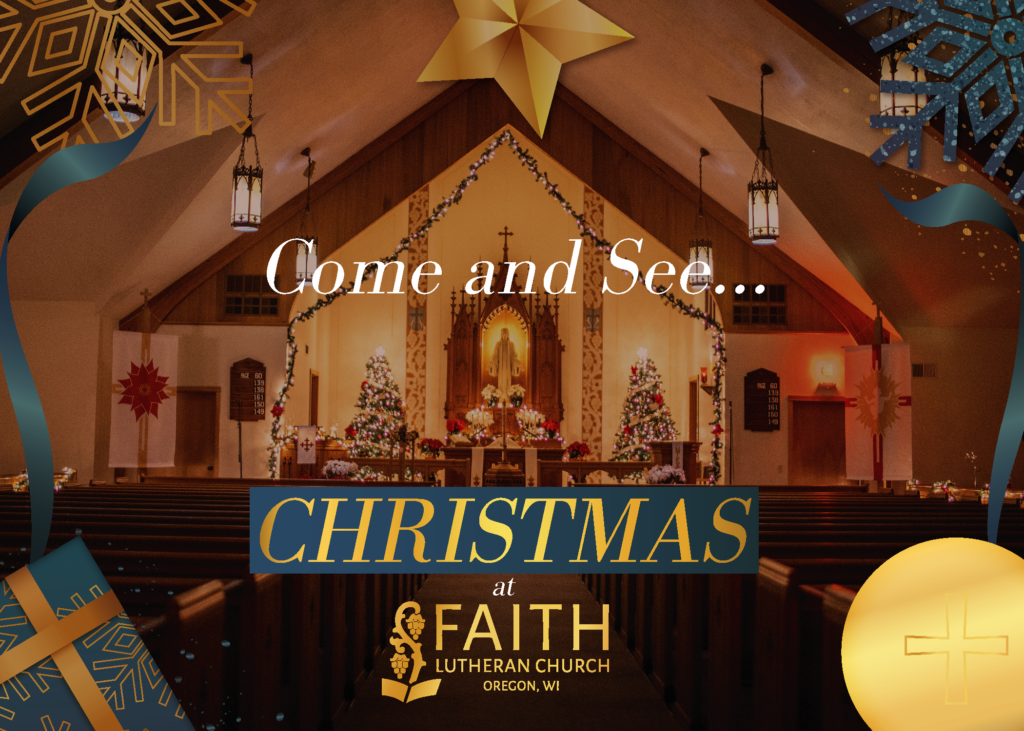
The first words spoken to the first disciple of Jesus: “Come and see.” This Advent & Christmas season we invite you to “come and see,” like Andrew, just how wonderful this Messiah truly is.
Celebrate Christ’s Mass with us at Faith’s Christmas Services in Oregon, WI. In three different services – not in style, but in theme – hear from each of the three accounts of our Savior’s Incarnation in Scripture. We warmly welcome you to come to any, and we encourage you to come to all.
We know you will be richly blessed. Come and see your Savior!
Christmas Eve Vespers – 6:30pm
Midnight Mass – 11:00pm
Christmas Day Divine Service – 9:00am
Catechesis for Advent-Christmas
Download the family Catechesis readings for Nov. 27-Jan. 5:
- « Previous Page
- 1
- …
- 4
- 5
- 6
- 7
- 8
- …
- 26
- Next Page »